
Products

LT Power Supply Cable
LT Control Cable
LT Railway Signalling Cables
LT Submersible Cable
LT Flexible & Cord Cables
LT Multistrand Flexible Cables
LT Telephone and LAN Cables
LT Aerial Bunch Cables
LT Co-Axial Cable
LT Special Purposes Cables
Instrumental Cables
Solar Cables
All Aluminium Alloy Stranded Conductors
Aluminium Conductors Steel - Reinforced (ACSR)
Contact Form
✉ Enquiry Form

Blog &
Industry Insights
Latest updates from cable technology and electrical industry.
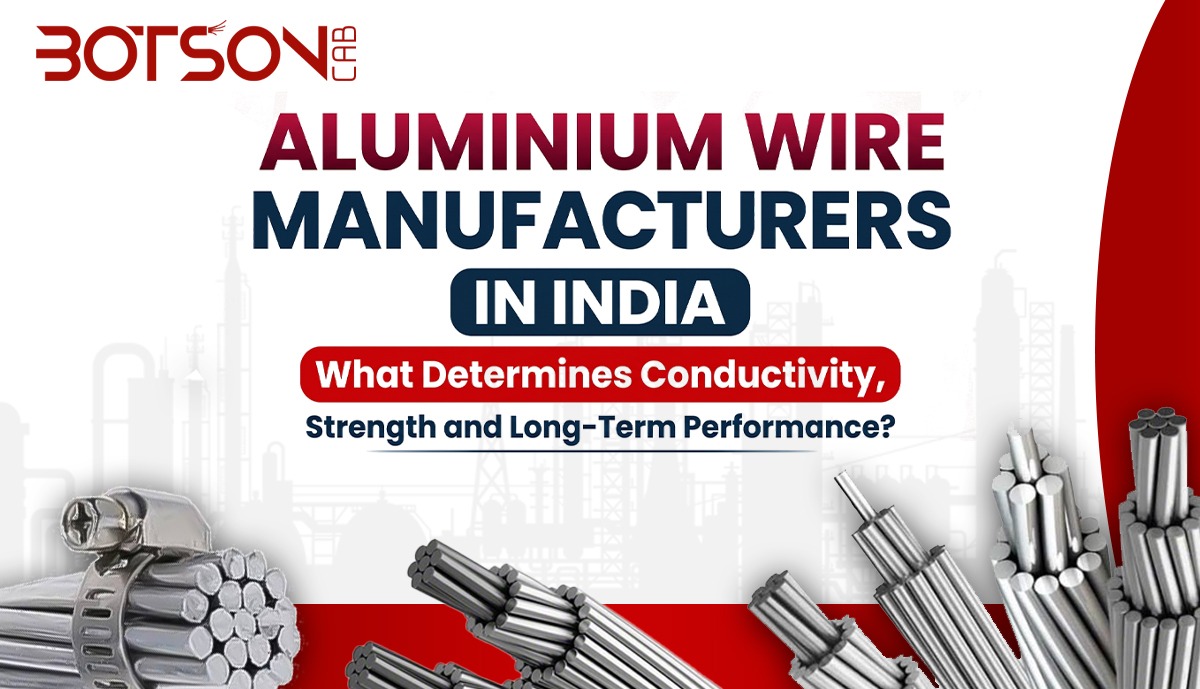
ALUMINIUM WIRE MANUFACTURERS IN INDIA: WHAT DETERMINES CONDUCTIVITY, STRENGTH AND LONG-TERM PERFORMANCE?
Industrial Wiring
28-10-2026
An aluminium wire may look simple, but its electrical performance depends on the quality of the aluminium, wire dimensions, electrical resistance and the application for which it is manufactured. A small difference in conductor specifications can affect current-carrying capacity, heating, mechanical strength and the overall performance of an electrical installation.
For electrical contractors, power distribution companies, infrastructure developers and bulk buyers, selecting the right Aluminium wire manufacturers in India is therefore an important purchasing decision.
Botsoncab manufactures electrical wires and cables and offers aluminium-based conductor solutions, including Aluminium Conductors Steel Reinforced (ACSR) and All Aluminium Alloy Stranded Conductors. These products serve applications where electrical conductivity and conductor strength are important requirements.
What Is Aluminium Wire?
Aluminium wire is an electrical conductor drawn from high-purity aluminium rod. It carries current in houses, factories, distribution lines, solar plants and overhead transmission networks.
Most electrical-grade wire is made from EC grade aluminium (1350 series), which is at least 99.5% pure. This purity gives the metal its good conductivity. The rod is drawn through dies to the required diameter, then either left hard for overhead lines or annealed (softened) for easier bending inside cables.
You will find aluminium wire in:
- Overhead lines and distribution networks
- Armoured and unarmoured power cables
- Service drops and building feeders
- Transformer windings
- Solar and industrial power systems
Key Features of Aluminium Electrical Wire
1. Lightweight construction
Aluminium weighs considerably less than copper for the same volume. This can help reduce conductor weight, particularly in overhead power transmission applications.
2. Electrical conductivity
Aluminium conducts electricity efficiently, although its electrical resistance is higher than copper for the same conductor dimensions. Proper conductor sizing is essential to achieve the required electrical performance.
3. Suitable for large-scale power networks
Aluminium conductors are widely used in overhead electricity transmission and distribution. ACSR designs combine aluminium strands with a steel core to provide additional mechanical strength.
4. Multiple conductor constructions
Depending on the application, buyers can specify aluminium wire, stranded conductors or aluminium alloy conductors with different mechanical and electrical characteristics.
Types of Aluminium Wires and Conductors Used in Industry
Not every Aluminium conductor serves the same purpose. The correct product depends on the installation, required strength and applicable technical specification.

1. Aluminium Wire
Aluminium wire is the base product, drawn from electrical grade aluminium rod, and used to make cables, windings and conductors. Choose the grade and temper (hard or soft) according to whether your work is in manufacturing or in the field.
2. AAC (All Aluminium Conductor)
AAC is made of stranded aluminium wires, which gives high conductivity at a low weight. It works best for overhead distribution lines in cities and short spans, where extra mechanical strength is not the main need.
3. AAAC (All Aluminium Alloy Conductor)
AAAC uses stranded aluminium alloy wires, giving better strength than AAC while staying light and conductive. It is a good pick for overhead lines that need a balance of strength and conductivity, including humid and coastal areas.
4. ACSR (Aluminium Conductor Steel Reinforced)
ACSR has aluminium strands wrapped around a steel core, so the steel carries the pulling load and the aluminium carries the current. It suits long-span overhead transmission lines, river crossings and routes where extra mechanical strength is a must.
Which standards should buyers check?
For electrical aluminium wire and overhead conductors, the applicable standard depends on the product category. Relevant references include IS 2067 for wrought aluminium wire for electrical purposes, IS 8130 for conductors used in insulated electrical cables, and IS 398 for specified overhead conductor constructions. The buyer should verify the applicable edition and requirements for the exact product.
Do not assume that every aluminium wire or conductor follows the same standard. Ask the manufacturer to confirm the applicable specification and provide supporting test documents where required.
Aluminium's lower weight can be advantageous, but copper generally offers higher conductivity for the same cross-sectional area. Aluminium conductors often require a larger cross-section to meet the same electrical resistance target. The final choice should be based on engineering requirements rather than material price alone.
What Affects the Performance of Aluminium Wire?
Three factors deserve particular attention during procurement.
Material quality
The aluminium grade and composition must match the required application. Material quality affects electrical and mechanical properties.
Dimensional accuracy
The specified diameter or cross-sectional area must be maintained. An incorrect conductor size can affect resistance and electrical performance.
Manufacturing and testing
Buyers should request relevant test reports and confirm that the product meets the agreed requirements. For stranded conductors, construction, wire dimensions, resistance and mechanical properties may all be important.
These checks are particularly relevant for electrical infrastructure projects, where replacing a conductor after installation can involve significant labour, shutdowns and transport costs.
Why Choose Botsoncab for Aluminium Wire and Conductors?
Botsoncab, based in Ghaziabad, Uttar Pradesh, offers electrical wire and cable solutions for residential, commercial, industrial and infrastructure requirements. Its product range includes ACSR and All Aluminium Alloy Stranded Conductors.
Businesses sourcing aluminium conductors can contact Botsoncab to discuss their project requirements, including:
- Application requirements: Identify whether the project requires an aluminium alloy conductor, ACSR or another suitable product.
- Technical specifications: Share the required conductor size, construction, applicable standard and project-specific conditions.
- Bulk procurement: Discuss quantities, delivery requirements and the specifications needed for a commercial or infrastructure order.
- Product documentation: Confirm the availability of relevant test reports and compliance documents before finalising the purchase.
Rather than ordering only by product name, buyers should share their technical requirements so the proposed product can be evaluated against the intended application.
Visit the Botsoncab aluminium conductor product page or contact Botsoncab to discuss your requirements.
Conclusion
Choosing among aluminium wire manufacturers in India requires more than comparing quotations. Material grade, conductor dimensions, electrical resistance, mechanical strength and compliance with the relevant standard all influence whether a product is suitable for its intended application.
Frequently Asked Questions
1. Who are the aluminium wire manufacturers in India?
India has manufacturers supplying aluminium wires, electrical conductors and specialised conductor constructions. Buyers should compare the manufacturer's product range, applicable standards, technical specifications and testing documentation. Botsoncab offers ACSR and All Aluminium Alloy Stranded Conductors.
2. Is aluminium wire suitable for power transmission?
Yes. Aluminium conductors are widely used in overhead power transmission and distribution. The appropriate conductor type depends on electrical loading, span length, mechanical strength and project specifications.
3. What is the difference between AAC, AAAC and ACSR conductors?
AAC uses stranded aluminium wires, AAAC uses aluminium alloy strands, and ACSR combines aluminium strands with a steel core. Their electrical and mechanical properties differ, so selection depends on the application.
4. Is aluminium wire cheaper than copper wire?
Aluminium often costs less per unit of weight, but the complete project cost also depends on conductor size, installation, accessories, electrical losses and maintenance requirements. Compare products against the same engineering criteria.
5. What details should I provide when requesting an aluminium wire quotation?
Provide the application, conductor type, required size, quantity, applicable standard, technical specifications, delivery location and any documentation requirements. This helps the manufacturer prepare a more relevant quotation.

Ready to get started?
Subscribe to our Newsletter
Stay connected with the latest trends and updates in the cables and wires industry.

Stay connected with the latest updates, innovations, and offers from BotsonCab. Join our newsletter to receive exclusive content, industry insights, and more directly to your inbox.
OFFICIAL INFO
Botsoncab , TYCON INDIA LLP D-11, Site-1, Bulandshahr Road Industrial Area, Ghaziabad, Uttar Pradesh- 201009
info@botsoncab.com
hr@botsoncab.com
+91-87961 03013
COPYRIGHTS © 2025-26 ALL RIGHTS RESERVED. POWERED BY BOTSONCAB
Developed and Maintained By Blue Brain Technologies Pvt. Ltd.