
Products

LT Power Supply Cable
LT Control Cable
LT Railway Signalling Cables
LT Submersible Cable
LT Flexible & Cord Cables
LT Multistrand Flexible Cables
LT Telephone and LAN Cables
LT Aerial Bunch Cables
LT Co-Axial Cable
LT Special Purposes Cables
Instrumental Cables
Solar Cables
All Aluminium Alloy Stranded Conductors
Aluminium Conductors Steel - Reinforced (ACSR)
Contact Form
✉ Enquiry Form

Blog &
Industry Insights
Latest updates from cable technology and electrical industry.
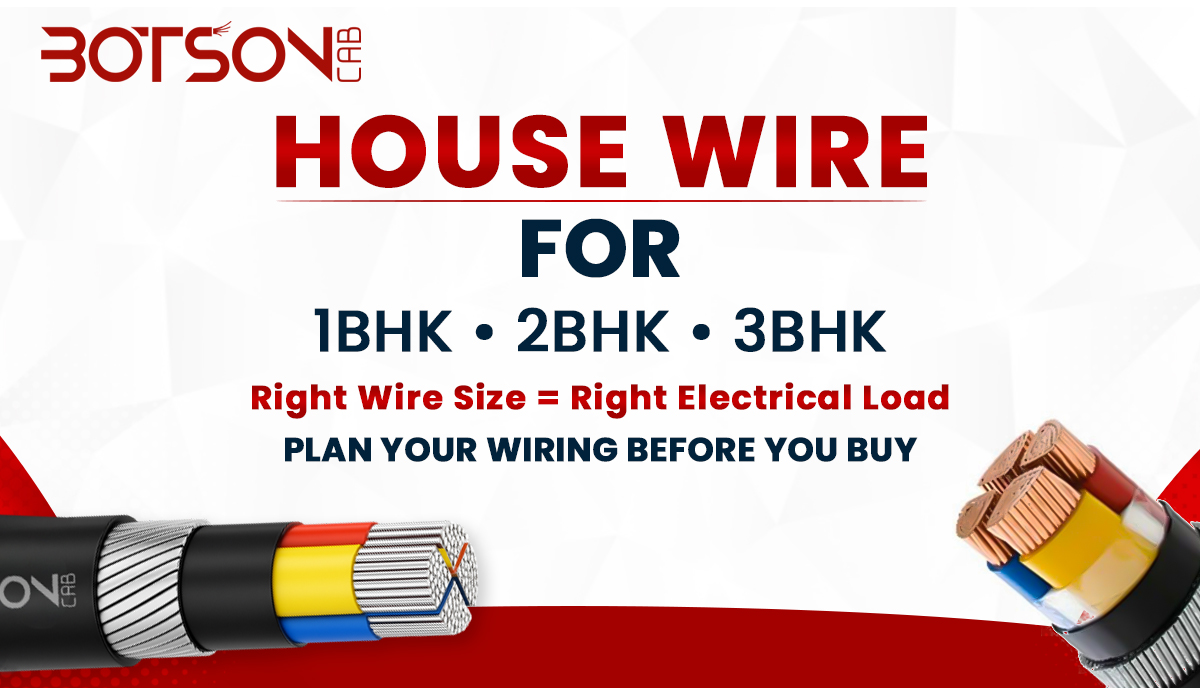
HOUSE WIRE FOR 1BHK, 2BHK AND 3BHK HOMES: WIRING REQUIREMENTS EXPLAINED
Installation Guide
10-08-2026
Choosing the house wiring for a new home involves more than just buying a roll of wire and installing it. Wiring requirements for 1BHK, 2BHK, and 3BHK homes depend on factors such as the number of rooms, the location of electrical points, the appliances being used, the connected load, and the circuit arrangement.
You cannot use the same wire size everywhere; different types of wiring may be required for lighting circuits, socket circuits, air conditioners, geysers, and other high-load appliances. For homeowners planning to build a new house, renovate, or rewire, this blog explains how wiring needs vary based on home size and outlines the key points to discuss with an electrician before purchasing wires.
Do 1BHK, 2BHK and 3BHK Need Different House Wire?
While the type Home wiring may not necessarily differ, the total quantity, circuit distribution, and required wire sizes can vary significantly. Wire size is not determined simply by the number of bedrooms; rather, it is dictated by the electrical load.
For instance, a 1BHK home equipped with an AC, geyser, refrigerator, washing machine, and other heavy appliances might require a higher electrical capacity than a 2BHK home with fewer appliances.
When purchasing wiring for your home, consider the following factors:
- The number of lighting and fan points
- The number of general-purpose sockets
- Requirements for ACs and geysers
- Appliances used in the kitchen
- Washing machine and refrigerator
- Load from water pumps or other motors
- Potential future increase in electrical load
- Arrangement of the distribution board and circuits
Therefore, the choice of wiring should be based on the electrical design rather than just the home's carpet area
House Wire Requirements for a 1BHK Home
A typical 1BHK generally includes a bedroom, living area, kitchen and bathroom. However, the actual wiring requirement depends on the appliances and electrical points planned.
Typical circuits may include:
- Lighting and fan circuits
- General socket circuits
- Kitchen sockets
- Dedicated circuit for an AC, if installed
- Dedicated geyser circuit, if required
- Refrigerator and washing-machine connections
- Other dedicated appliance circuits
For smaller homes, homeowners sometimes try to reduce the number of circuits to save on installation costs. This can create problems later when the electrical load increases.
A better approach is to plan circuits according to actual and expected appliance loads instead of treating the 1BHK as a “small load” automatically.
House Wire Requirements for a 2BHK Home
A 2BHK normally has more lighting points, fans, sockets and appliances than a 1BHK. There may also be multiple ACs, additional bathroom appliances and a larger kitchen setup.
The wiring plan commonly needs separate consideration for:
- Bedrooms
- Living and dining areas
- Kitchen
- Bathrooms
- AC points
- Geyser points
- Washing machine
- Refrigerator
- Heavy kitchen appliances
- General-purpose sockets
A useful planning step is to make an appliance list before buying house wire.
For example, if you initially plan one AC but expect to install another bedroom AC later, tell your electrician before the wiring work starts. Future load requirements can influence circuit planning and distribution-board capacity.
House Wire Requirements for a 3BHK Home
A 3BHK usually has a greater number of electrical points and potentially higher connected load. However, there is no universal “3BHK wire size” because two homes with the same number of bedrooms can have completely different electrical requirements.
A 3BHK may require circuits for:
- Multiple bedrooms
- Living and dining areas
- Kitchen appliances
- Multiple AC units
- Geysers
- Washing machine
- Refrigerator
- Water pump
- Entertainment equipment
- General sockets
- Outdoor or utility-area points
At this stage, circuit separation becomes particularly important. A properly planned installation makes it easier to isolate a faulty circuit and reduces the need to shut down the entire home's electrical supply during maintenance.
Which House Wire Size Should You Use?
There is no single wire size that is correct for every point in a home.
Common conductor sizes used in residential wiring may include 1.5 sq. mm, 2.5 sq. mm, 4 sq. mm and higher, depending on the application and electrical load.
As a general planning concept:
Home Application - Wire Size Consideration
Lighting and fan circuits - Often lower cross-sectional area
Often lower cross-sectional area - Typically higher than lighting circuits
Kitchen appliances - Depends on individual appliance load
AC circuits - Dedicated circuit and appropriate sizing required
Geyser - Dedicated circuit with suitable sizing
High-load equipment - Requires load-based electrical design
Important: These are planning categories, not a substitute for electrical design. The final conductor size should be selected by a qualified electrician/electrical professional based on load, installation method, permissible voltage drop, protection and applicable standards.
Why 1.5 Sq. mm Wire Shouldn't Automatically Be Used Everywhere
One of the common mistakes in residential wiring is assuming that one wire size can handle the entire house.
A lighting circuit and an air-conditioner circuit do not have the same electrical demand.
If a circuit is carrying more current than the conductor and protective arrangement are designed for, excessive heating and other electrical risks can result.
The correct approach is to match conductor size, circuit protection and expected load rather than choosing wire purely on price.
What Should You Check Before You Buy House Wire?
Before you buy house wire for your home, don't look at the price per coil alone. Check the product specifications and manufacturer's quality practices.
1. Conductor Material
Copper is widely used for residential wiring because of its electrical conductivity and suitability for flexible building-wire applications.
2. Insulation Quality
The insulation must be suitable for the intended installation and operating conditions. Depending on the product, manufacturers may offer insulation options designed for different performance requirements.
3. Applicable Standards
Check the applicable Indian Standard: For PVC-insulated cables/cords covered by the relevant product category, verify the manufacturer's applicable BIS requirements and certification. Electrical installation design and selection should also follow the applicable requirements of IS 732:2019 and other relevant standards.
4. Manufacturer's Quality Control
Ask where the wire is manufactured and what testing and quality-control procedures are followed.
5. Correct Markings
Product markings, conductor size, voltage rating and other specifications should be clearly identifiable.
6. Actual Requirement
Don't purchase wire based only on the size of your home. Your electrician should calculate the requirement based on circuits, loads and installation conditions.
How Much House Wire Does a 1BHK, 2BHK or 3BHK Need?
There is no reliable fixed quantity based only on BHK size.
A 1BHK with extensive electrical points may consume more wire than a minimally equipped 2BHK. Similarly, a 3BHK with multiple ACs and additional appliances can require substantially more wiring.
The quantity depends on:
- Number of electrical points
- Number of circuits
- Distance between distribution board and points
- Number of floors
- Conduit routing
- Appliance locations
- Switchboard positions
- Future wiring provisions
The most accurate method is to prepare a point schedule and wiring layout before purchasing material.
Why Buying House Wire From an Experienced Manufacturer Matters
Residential wiring is installed inside walls, conduits and ceilings, where replacing a poor-quality wire later can involve considerable labour and disruption.
This makes the manufacturer's manufacturing process and quality controls important.
When comparing House Wire Manufacturers in India, look beyond marketing claims. Check the manufacturer's product specifications, applicable standards, manufacturing capabilities, testing practices and consistency of supply.
Botsoncab: House Wire for Residential Electrical Applications
Botsoncab, manufactures wires and cables for residential, commercial, industrial and infrastructure applications.
The company focuses on material quality, manufacturing consistency and electrical performance across its cable range. For homeowners, contractors and electrical professionals, selecting the right product should still be based on the project's actual load and installation requirements.
1BHK vs 2BHK vs 3BHK: What Actually Changes?
The easiest way to understand the difference is this:
1BHK: Fewer rooms and generally fewer electrical points, but heavy appliances can still create significant load.
2BHK: More rooms and circuits, with greater scope for multiple ACs, kitchen appliances and additional sockets.
3BHK: More electrical points and potentially higher connected load, making circuit separation and future-load planning even more important.
So, BHK size helps estimate the scope of wiring—but it does not determine the correct wire size by itself.
Conclusion
A house wire requirement is determined by electrical load and circuit design—not simply whether the property is a 1BHK, 2BHK or 3BHK. Before purchasing, prepare the appliance list, identify dedicated circuits, discuss future electrical requirements with your electrician and select the conductor size according to the actual application.
For homeowners looking to buy house wire for home, choosing a manufacturer with clear product specifications and established quality-control practices can make a significant difference because residential wiring is expected to perform reliably for years after installation
Frequently Asked Questions (FAQ)
1. What house wire size is commonly used for home wiring?
Common residential conductor sizes include 1.5 sq. mm, 2.5 sq. mm, 4 sq. mm and higher, but the appropriate size depends on the circuit load, installation conditions and applicable electrical requirements.
2. Is the same house wire used for lights and AC?
Not necessarily. ACs generally require dedicated circuits designed around their electrical load, while lighting circuits have different requirements.
3. How much house wire is required for a 2BHK?
There is no standard quantity. The requirement depends on electrical points, circuit layout, conduit routing, appliance locations and the size of the installation.
4. What should I check before I buy house wire for my home?
Check conductor material, wire size, voltage rating, insulation, applicable standards, manufacturer quality practices and suitability for the intended electrical application.
5. How do I compare House Wire Manufacturers in India?
Compare their manufacturing capabilities, product specifications, applicable certifications/standards, quality-control systems, testing practices and consistency rather than choosing solely on price.
You may also like - HOUSE WIRE MANUFACTURERS IN INDIA: A COMPLETE GUIDE TO CHOOSING SAFE AND RELIABLE HOUSE WIRES

Ready to get started?
Subscribe to our Newsletter
Stay connected with the latest trends and updates in the cables and wires industry.

Stay connected with the latest updates, innovations, and offers from BotsonCab. Join our newsletter to receive exclusive content, industry insights, and more directly to your inbox.
OFFICIAL INFO
Botsoncab , TYCON INDIA LLP D-11, Site-1, Bulandshahr Road Industrial Area, Ghaziabad, Uttar Pradesh- 201009
info@botsoncab.com
hr@botsoncab.com
+91-87961 03013
COPYRIGHTS © 2025-26 ALL RIGHTS RESERVED. POWERED BY BOTSONCAB
Developed and Maintained By Blue Brain Technologies Pvt. Ltd.