
Products

LT Power Supply Cable
LT Control Cable
LT Railway Signalling Cables
LT Submersible Cable
LT Flexible & Cord Cables
LT Multistrand Flexible Cables
LT Telephone and LAN Cables
LT Aerial Bunch Cables
LT Co-Axial Cable
LT Special Purposes Cables
Instrumental Cables
Solar Cables
All Aluminium Alloy Stranded Conductors
Aluminium Conductors Steel - Reinforced (ACSR)
Contact Form
✉ Enquiry Form
Blog &
Industry Insights
Latest updates from cable technology and electrical industry.
PVC WIRE MANUFACTURERS IN INDIA: FROM RAW MATERIALS TO FINISHED WIRE—WHERE QUALITY IS REALLY BUILT
Industrial Wiring
14-08-2026
When buyers search for PVC Wire Manufacturers in India, they are usually not looking for a company name alone. They want to know whether the manufacturer can consistently deliver wires that are safe, durable, electrically reliable and suitable for the intended application. That reliability does not begin when a finished wire is packed. It starts much earlier—with conductor material, PVC compounds, manufacturing controls, insulation quality and testing.
For electrical contractors, distributors, OEMs, builders and project buyers, understanding these stages makes it easier to evaluate a PVC wire manufacturer beyond price and product appearance.
What Makes a PVC Wire Manufacturer Reliable?
A reliable manufacturer is not defined simply by having a large product catalogue. The more important question is how consistently the manufacturer controls quality throughout production.
Several factors contribute to finished wire quality:
- Conductor material and electrical properties
- Quality of PVC insulation
- Accurate conductor sizing
- Proper insulation thickness
- Manufacturing consistency
- Electrical and physical testing
- Quality inspection before dispatch
- Compliance with applicable standards
A manufacturer that controls these areas can provide more consistent performance across different production batches.
This is particularly important when wires are being used for residential wiring, commercial buildings, electrical panels, machinery or other installations where conductor performance and insulation reliability directly affect the electrical system.
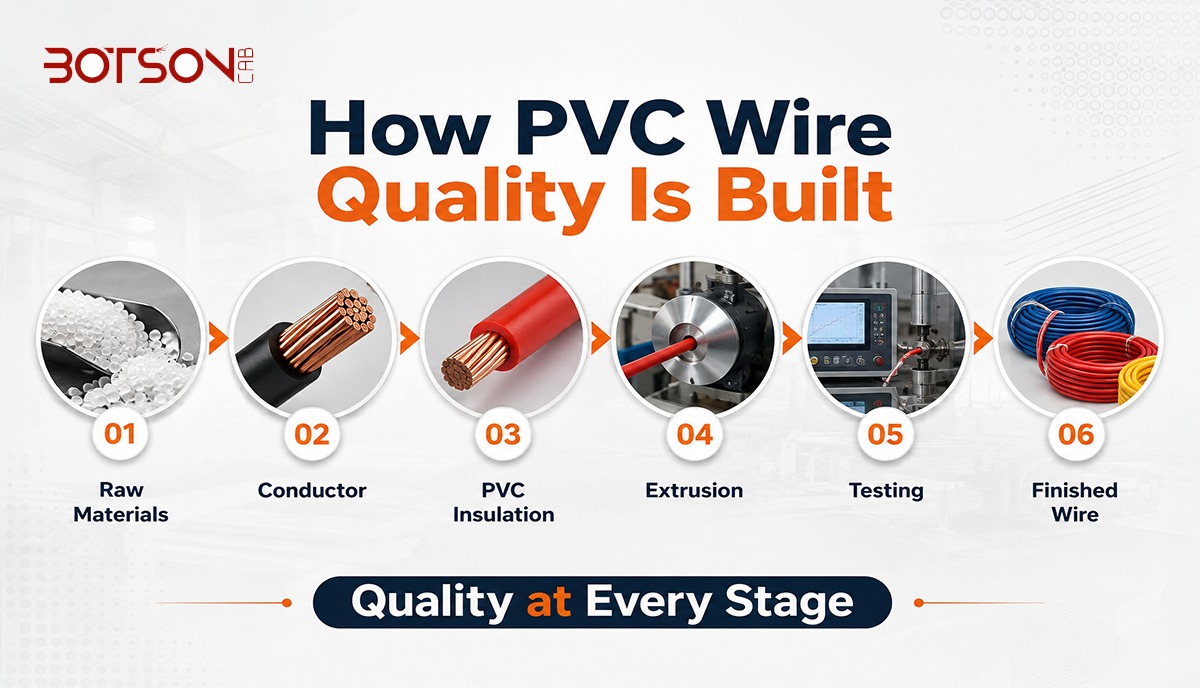
1. Quality Starts With Raw Material Selection
The first major quality checkpoint is the selection of raw materials.
For a PVC insulated wire, the conductor generally uses copper or aluminium, while PVC-based compounds are used for insulation. The characteristics of these materials influence the finished product's conductivity, flexibility, mechanical strength and resistance to operating conditions. Poor-quality or inconsistent raw materials can create problems later in production, even when the finished wire looks acceptable.
For this reason, manufacturers need appropriate controls for incoming materials before they enter the production process.
For buyers comparing PVC Wire Manufacturers in India, asking about material sourcing and incoming quality checks can provide more meaningful information than simply comparing quoted prices.
2. The Conductor Determines Electrical Performance
The conductor is the part of the wire responsible for carrying electrical current, making its quality particularly important.
Copper conductors are widely used where high conductivity and good flexibility are required, while aluminium conductors can be suitable for applications where their specific characteristics and cost advantages are appropriate.
But selecting the right metal is only one part of the process.
The conductor must also have the required dimensions, construction and consistency. During manufacturing, processes such as wire drawing and stranding need to be properly controlled so that the conductor achieves the intended characteristics.
For a buyer, this means that conductor quality should be evaluated along with the manufacturer's production controls, rather than treating the conductor material alone as a quality guarantee.
3. PVC Insulation Is More Than Just a Protective Layer
The PVC layer surrounding the conductor performs an important electrical and mechanical function.
It provides insulation between the conductor and the external environment while helping protect the wire from physical conditions encountered during installation and use.
The quality of the PVC compound, formulation and extrusion process can influence:
- Insulation strength
- Flexibility
- Surface finish
- Mechanical durability
- Resistance to environmental conditions
- Long-term electrical reliability
The insulation also needs to maintain appropriate thickness and uniformity throughout the wire.
This is where manufacturing precision becomes important. A visually smooth outer surface does not necessarily tell a buyer whether the insulation has been produced with consistent dimensions or meets the required technical specifications.
4. Manufacturing Consistency Is Where Quality Gets Built
One production batch may look similar to another, but reliable wire manufacturing requires much more than visual consistency.
During production, the conductor and insulation need to work together within specified dimensions and process conditions.
The extrusion stage is particularly important because PVC insulation is applied around the conductor under controlled manufacturing conditions.
Variables such as temperature, extrusion speed, material flow and dimensional control can affect the finished insulation.
A manufacturer with defined process controls can reduce variation between batches and maintain more predictable product performance.
This is one reason why buyers should evaluate manufacturing capability and quality systems, rather than choosing a PVC wire supplier solely on the basis of price.
5. Testing Separates a Finished Wire From a Quality Wire
Testing is one of the most important stages before a wire reaches the customer.
Depending on the product and applicable requirements, manufacturers may carry out electrical, dimensional and physical checks.
These can include checks related to:
- Conductor resistance
- Insulation performance
- Insulation dimensions
- Overall dimensions
- Physical properties
- Visual and construction quality
Testing helps identify deviations before products are dispatched.
For project buyers, documentation and traceability can also be valuable. A manufacturer that maintains appropriate quality records can provide greater confidence when wires are being purchased for larger or technically demanding applications.
What Should Buyers Check Before Choosing PVC Wire Manufacturers in India?
Instead of asking only, “What is the price per metre?”, buyers should evaluate the manufacturer using several practical questions.
1. What conductor materials are available?
Check whether the manufacturer offers copper, aluminium or specific conductor constructions required for your application.
2. How is the PVC insulation controlled?
Ask about insulation type, thickness, consistency and the manufacturer's quality-control process.
3. What testing is performed?
A credible manufacturer should be able to explain the relevant testing procedures used for its products.
4. Are applicable standards followed?
The wire should be manufactured and tested according to the applicable Indian or relevant industry standards for the particular product.
5. Can the manufacturer maintain batch-to-batch consistency?
This matters especially for distributors, contractors, OEMs and infrastructure projects purchasing significant quantities.
6. Does the manufacturer understand the application?
A manufacturer should be able to guide buyers toward an appropriate wire construction rather than simply selling the nearest available product.
Why Manufacturing Experience Matters
Experience becomes valuable when it translates into better process control and more consistent production.
A manufacturer familiar with different electrical applications is better positioned to understand the practical requirements associated with conductor construction, insulation, sizing and testing.
However, buyers should not rely on experience claims alone. Manufacturing capability, testing practices, product specifications and quality documentation provide stronger evidence of technical credibility.
That is the practical side of EEAT in the electrical manufacturing industry: demonstrate expertise through measurable manufacturing practices rather than making unsupported claims.
Botsoncab: A Quality-Focused Approach to Wire Manufacturing
Botsoncab approaches wire and cable manufacturing with an emphasis on product quality, manufacturing consistency and application requirements. The company manufactures a range of wires and cables for different electrical applications, with attention to conductor selection, insulation and product specifications.
For buyers evaluating PVC Wire Manufacturers in India, the important consideration is not simply where a wire is manufactured. It is whether the manufacturer has the production capability, quality controls and testing approach required to deliver consistent products for the intended application.
That is the standard buyers should apply when comparing manufacturers.
Conclusion
A PVC wire may look simple from the outside, but its reliability is influenced by several stages of manufacturing.
Raw material selection → conductor processing → PVC insulation → extrusion → dimensional control → testing → final inspection Every stage contributes to the final product. Therefore, when comparing PVC Wire Manufacturers in India, buyers should look beyond price, packaging and appearance. Evaluate the manufacturer's raw material controls, conductor quality, insulation process, testing practices, applicable standards and ability to maintain consistency.
The real measure of wire quality is not simply what the finished product looks like. It is how carefully quality has been built into every stage before that wire reaches the customer.
Frequently Asked Questions
1. What should I check when choosing PVC Wire Manufacturers in India?
Check conductor quality, PVC insulation, manufacturing consistency, testing procedures, applicable standards, product specifications and the manufacturer's ability to maintain consistent quality across batches.
2. Why is raw material quality important in PVC wires?
Raw materials directly influence conductor performance and insulation characteristics. Consistent materials help manufacturers achieve more predictable electrical and mechanical properties in the finished wire.
4. Is PVC insulation important for electrical wire safety?
Yes. PVC insulation provides electrical separation around the conductor and helps protect the wire during installation and operation. Its quality, thickness and consistency are important considerations.
5. How can buyers compare different PVC wire manufacturers?
Compare manufacturers based on technical specifications, conductor construction, insulation quality, testing procedures, applicable standards, manufacturing capabilities and quality documentation—not price alone.

Ready to get started?
Subscribe to our Newsletter
Stay connected with the latest trends and updates in the cables and wires industry.

Stay connected with the latest updates, innovations, and offers from BotsonCab. Join our newsletter to receive exclusive content, industry insights, and more directly to your inbox.
OFFICIAL INFO
Botsoncab , TYCON INDIA LLP D-11, Site-1, Bulandshahr Road Industrial Area, Ghaziabad, Uttar Pradesh- 201009
info@botsoncab.com
hr@botsoncab.com
+91-87961 03013
COPYRIGHTS © 2025-26 ALL RIGHTS RESERVED. POWERED BY BOTSONCAB
Developed and Maintained By Blue Brain Technologies Pvt. Ltd.