
Products

LT Power Supply Cable
LT Control Cable
LT Railway Signalling Cables
LT Submersible Cable
LT Flexible & Cord Cables
LT Multistrand Flexible Cables
LT Telephone and LAN Cables
LT Aerial Bunch Cables
LT Co-Axial Cable
LT Special Purposes Cables
Instrumental Cables
Solar Cables
All Aluminium Alloy Stranded Conductors
Aluminium Conductors Steel - Reinforced (ACSR)
Contact Form
✉ Enquiry Form
Blog &
Industry Insights
Latest updates from cable technology and electrical industry.
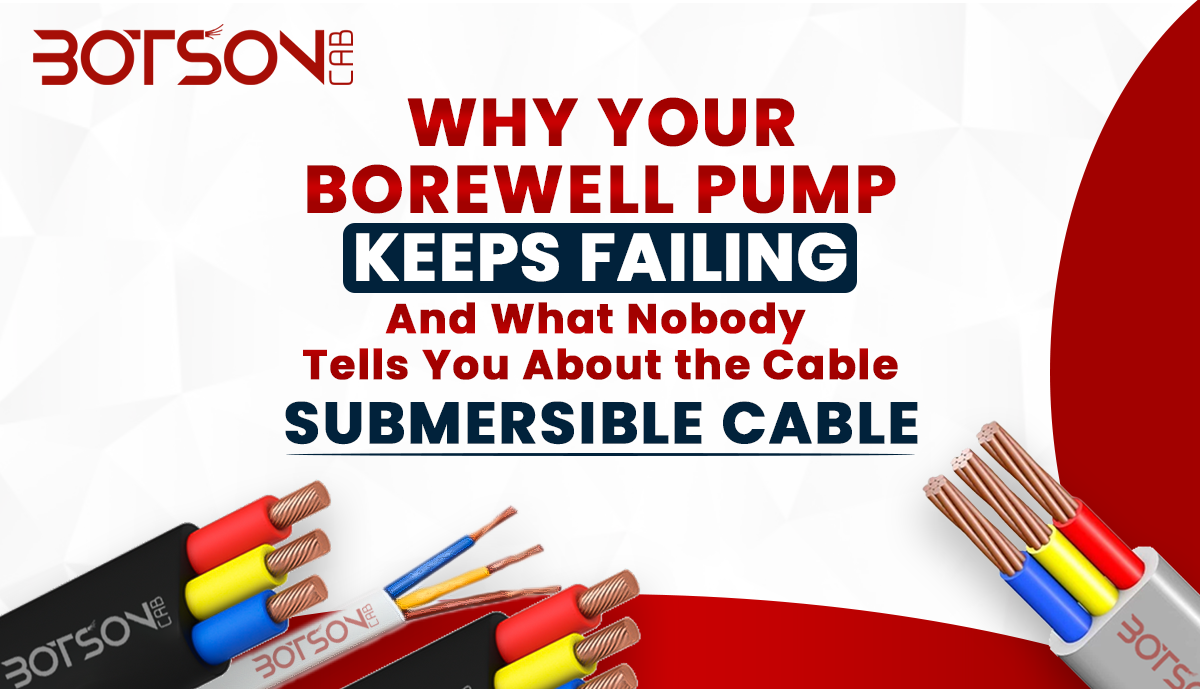
WHY YOUR BOREWELL PUMP KEEPS FAILING — AND WHAT NOBODY TELLS YOU ABOUT THE CABLE
Cable Technology
19-09-2026
Ask ten pump mechanics why a submersible motor burned out, and eight of them will blame the pump. Check the cable first. That's usually where the real problem is hiding. Submersible cables don't get much attention because they're buried underground doing their job quietly — until they're not. When they fail, the symptoms look like a motor problem: tripping, overheating, sudden power loss. By the time someone actually pulls the pump out and inspects the cable, the motor's already damaged and the repair bill has doubled.
At Botsoncab, as submersible cable manufacturers in India, we often hear the same story from customers: They chose a cheaper cable to save a few hundred rupees, only to face a motor rewinding cost ten times higher just six months later.
The Water Doesn't Care How Good Your Insulation Looks
Here's what separates a submersible cable from a regular wire: it has to survive constant contact with water, mineral deposits, pressure changes, and vibration — for years, without anyone checking on it. A normal PVC wire will absorb moisture slowly through microscopic gaps in the insulation. It might take a year, it might take five, but eventually the copper starts corroding from the inside.
Botsoncab builds specifically against this. The conductor is high-purity electrolytic copper, and the insulation compound is formulated to resist water absorption rather than just repel it on the surface — which matters more than it sounds, because repelling water and resisting long-term absorption are two very different engineering problems.
Flat, Round, or Does It Even Matter?
It does, but not for the reason most people think.
Flat cables aren't "better" than round ones — they exist because most borewells don't have room for anything else. A 6-inch or 8-inch bore doesn't leave space for a bulky round cable running alongside the pipe, so flat construction became the practical standard for domestic and agricultural wells. Round cables show up more in open wells or larger-diameter installations, where space isn't the constraint and durability under mechanical stress is prioritized instead.
Botsoncab makes both, and honestly, the deciding factor is almost never preference — it's your well diameter and pump size.
The Sizing Mistake That Costs People the Most
If there's one place we'd tell every customer to stop cutting corners, it's cable thickness.
People assume a thinner cable is fine as long as it "fits" the pump rating. It technically carries current, sure — but as the cable run gets longer (which happens with deeper borewells), voltage drop increases, and the motor starts working harder than it should just to compensate. That extra strain is what quietly kills motors early.
A rough field reference we give customers:
- Small domestic pumps (up to 1 HP), shallow wells under 150 ft — 1.5 sq mm is usually enough
- 1–3 HP pumps, 150–300 ft depth — step up to 2.5 or 4 sq mm
- 3–5 HP, 300–450 ft — 6 sq mm becomes necessary
- Anything heavier or deeper — 10 sq mm or above, and at that point, get the voltage drop calculated properly rather than guessing
That said, this is a starting point, not gospel. Every well is different, and the right call depends on actual site conditions — something our Botsoncab technical team walks customers through directly rather than just selling based on HP rating alone.
Joints Are Where Cables Actually Die
If you talk to anyone who's serviced hundreds of submersible pumps, they'll tell you the same thing: the cable rarely fails along its length. It fails at the joint. Every time a pump gets pulled out for repair and reinstalled, that joint gets remade — and if it's not sealed properly with a proper waterproof jointing kit or heat-shrink sleeve, water finds its way in eventually. It might hold for months. It won't hold forever. This is such a common failure point that we tell every Botsoncab customer the same thing at the point of sale: don't skimp on the joint kit, and don't let anyone rush that step during reinstallation.
What Actually Tells You a Cable Is About to Fail
Most people wait for total failure before replacing a cable. A few warning signs usually show up first, if you're paying attention:
- The overload relay trips more often than it used to, for no obvious reason
- The pump hesitates or delays before starting
- An insulation resistance test (using a megger) reads lower than it did last time
- The outer jacket looks swollen, cracked, or discolored when the pump's pulled out for any reason
Catching this early is the difference between replacing a cable and replacing a motor.
The Real Cost Comparison Nobody Makes
A slightly more expensive submersible cable from a manufacturer like Botsoncab costs more upfront — there's no getting around that. But run the actual numbers: a motor burnout from cable failure means pulling the pump, a rewind or replacement motor, labor, and downtime on whatever that water supply was feeding — irrigation, a household, a building.
Compare that to the price difference between a properly rated cable and a cheaper one. It isn't close.
Conclusion
A submersible pump doesn't work in isolation. The cable, motor, pump and electrical supply all have to work together. A cable that is correctly sized, properly insulated and suitable for continuous underwater use can help maintain reliable power delivery and reduce avoidable electrical stress on the motor. So before choosing a submersible cable based only on price, look at the pump rating, cable length, installation depth, voltage drop, insulation quality and jointing method. Saving a few hundred rupees on the cable can be a poor trade-off if it leads to repeated faults, downtime or motor repairs. At Botsoncab, we manufacture submersible cables for demanding borewell and water-pump applications, with cable selection based on the actual requirements of the installation.
FAQs
1. What cable is used for a submersible pump?
Submersible pumps use specially designed submersible cables with insulation suitable for continuous exposure to water and underground installation.
2. How do I choose the right submersible cable size?
Cable size depends on motor HP, operating voltage, cable length, installation conditions and allowable voltage drop. It should not be selected from HP alone.
3. Can a smaller cable damage a submersible motor?
Yes. An undersized cable can cause excessive voltage drop and electrical losses, which may increase motor heating and affect motor performance.
4. What is better: flat or round submersible cable?
Neither is universally better. Flat cables are commonly used where borewell space is limited, while round cables can be suitable where installation space and mechanical requirements allow them.
5. Why does a submersible cable fail?
Common causes include water ingress, incorrect cable sizing, poor joints, mechanical damage, insulation deterioration and unsuitable installation conditions.

Ready to get started?
Subscribe to our Newsletter
Stay connected with the latest trends and updates in the cables and wires industry.

Stay connected with the latest updates, innovations, and offers from BotsonCab. Join our newsletter to receive exclusive content, industry insights, and more directly to your inbox.
OFFICIAL INFO
Botsoncab , TYCON INDIA LLP D-11, Site-1, Bulandshahr Road Industrial Area, Ghaziabad, Uttar Pradesh- 201009
info@botsoncab.com
hr@botsoncab.com
+91-87961 03013
COPYRIGHTS © 2025-26 ALL RIGHTS RESERVED. POWERED BY BOTSONCAB
Developed and Maintained By Blue Brain Technologies Pvt. Ltd.